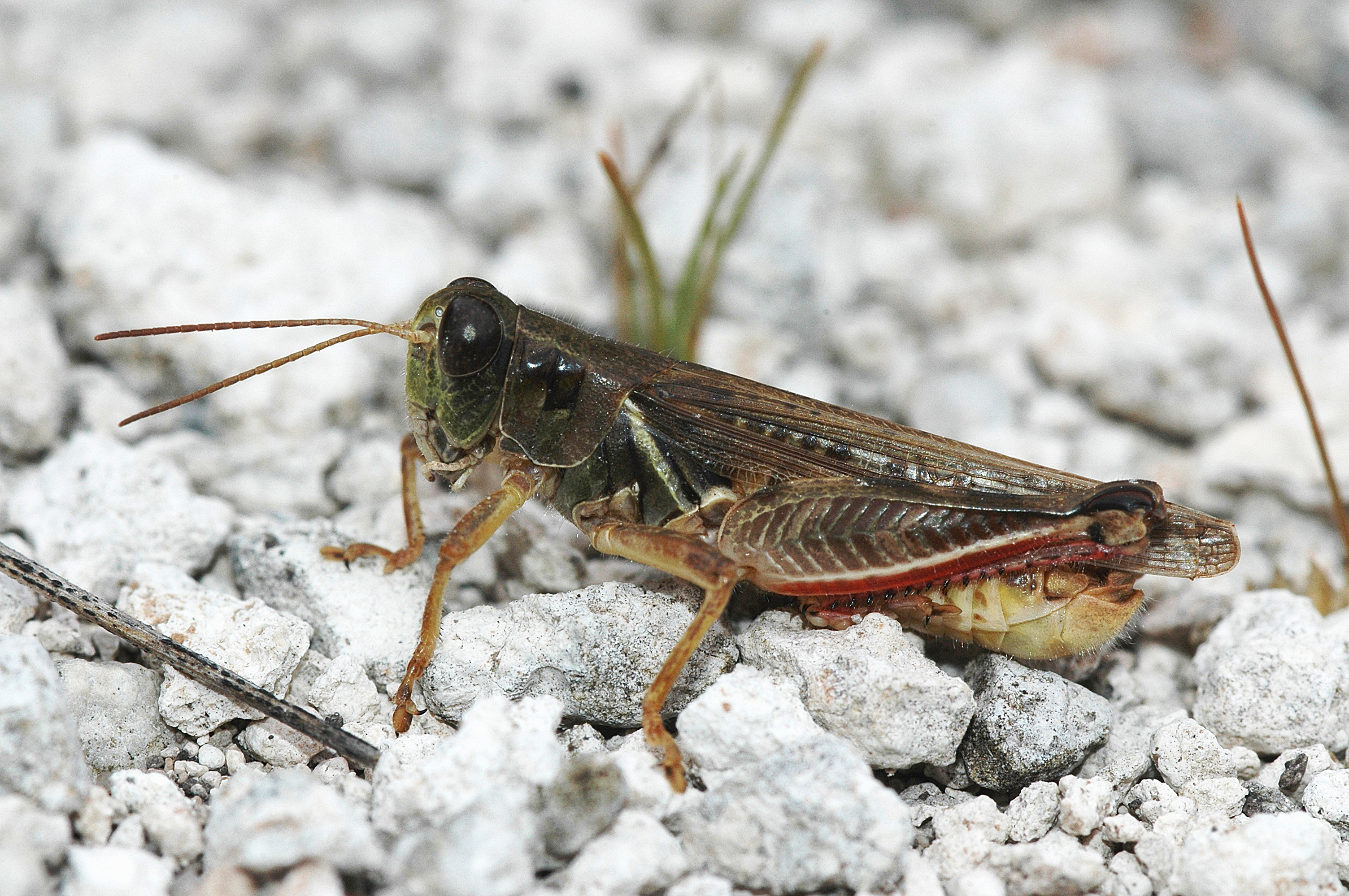
Melanoplus mexicanus (Saussure, 1861): male. (Otu).
Melanoplus mexicanus (Saussure, 1861): female. (Otu).
Melanoplus mexicanus (Saussure, 1861): Fig. 63. head and pronotum, dorsal view. (Otu).
Melanoplus mexicanus (Saussure, 1861): Fig. 84. male cercus, lateral view. (Otu).
Melanoplus mexicanus (Saussure, 1861): Fig. 94. apex of subgenital plate of male. (Otu).
Melanoplus mexicanus (Saussure, 1861): Fig. 56. mesosternum (cl - caudolateral lobes). (Otu).

Nomenclature (32)

  • Pezotettix mexicana Saussure, 1861: 160.

    Syntype; male; e5bef837-9b06-4661-9203-b8cceed0939a; deposited at: Museum d'Histoire Naturelle, Geneva, Switzerland (MHNG); Mexico: Oaxaca. Syntype; female; 422fcb0c-77e1-49fe-8d75-f56063359e3f; deposited at: Museum d'Histoire Naturelle, Geneva, Switzerland (MHNG); Mexico: Oaxaca

  • Caloptenus [sic] selectus Walker, 1870: 682.
  • ... Show all ... (28)
  • Melanoplus mexicanus (Saussure, 1861) in Barrientos-Lozano, Rocha-Sánchez, Buzzetti, Méndez-Gómez & Horta-Vega, 2013: 230.
  • Melanoplus mexicanus (Saussure, 1861) in Fontana, Buzzetti, Mariño-Pérez, Castellanos-Vargas, Monge-Rodríguez & Cano-Santana, 2017: 138.

Nomenclature references (30)

  • Barrientos-Lozano, L., Medina, R.F. & Rocha-Sánchez, A.Y. (2009) Contribution to geographic distribution of some Mexican Melanoplinae and description of a new species. Journal of Orthoptera Research, 18(1), 37–50. Available at http://www.bioone.org/doi/full/10.1665/034.018.0101
  • Barrientos-Lozano, L., Rocha-Sánchez, A.Y. & Horta-Vega, J.V. (2013) Two new species of Melanoplus Stål, 1873 (Orthoptera: Acrididae: Melanoplinae) from northeastern Mexico. Zootaxa, 3669(3), 261–286.
  • ... Show all ... (26)
  • Barrientos-Lozano, L., Rocha-Sánchez, A.Y., Buzzetti, F.M., Méndez-Gómez, B.R. & Horta-Vega, J.V. (2013) In Saltamontes y esperanzas del noreste de México (Insecta: Orthoptera). Guía ilustrada. Ciudad de México. 388 pp.
  • Bruner, L. (1908) Orthoptera. The Acrididae. Biologia Centrali-Americana, 2, 249–342. Available at http://www.sil.si.edu/digitalcollections/bca/navigation/bca_20_02_00/bca_20_02_00select.cfm
  • Cantrall, I.J. (1943) The ecology of the Orthoptera and Dermaptera of the George Reserve, Michigan. Miscellaneous Publications Museum of Zoology University of Michigan, 54, 1–184. Available at http://deepblue.lib.umich.edu/handle/2027.42/56299
  • de Saussure, H. (1861) Orthoptera nova americana (Diagnoses praeliminares). II. Revue et Magasin de Zoologie Pure et Appliquée, 2(13), 126–130, 156–164, 313–324, 397–402. Available at http://www.biodiversitylibrary.org/item/20623#page/138/mode/1up
  • Faure, J.C. (1933) The phases of the Rocky Mountain locust Melanoplus mexicanus (Saussure). Journal of Economic Entomology, 26, 706–718.
  • Fontana, P., Buzzetti, F.M. & Mariño-Pérez, R. (2008) In Chapulines, Langostas, Grillos y Esperanzas de México. Guía fotográfica - Grasshoppers, Locusts, Crickets & Katydids of Mexico. Photographic guide. World Biodiversity Association, Verona, Italy. 1–272 pp. Available at http://biodiversityassociation.org/wp-content/uploads/2016/05/Grasshoppers-Locusts-Crickets-Katydids-Of-Mexico.pdf
  • Fontana, P., Buzzetti, F.M., Mariño-Pérez, R., Castellanos-Vargas, I., Monge-Rodríguez, S. & Cano-Santana, Z. (2017) In Ortópteros de Oaxaca. Orthopterans of Oaxaca. WBA Handbooks 8, Verona. 1–212 pp.
  • Gurney, A.B. & Brooks, A.R. (1959) Grasshoppers of the Mexicanus Group, genus Melanoplus (Orthoptera: Acrididae). Proceedings of the United States National Museum, 110, 1–93. Available at http://www.biodiversitylibrary.org/item/53298#page/9/mode/1up
  • Gurney, A.B. (1962) On the name of the migratory grasshopper of the United States and Canada, Melanoplus sanguinipes (F.) (Orthoptera; Acrididae). Proceedings of the Biological Society of Washington, 75, 189–192. Available at http://www.biodiversitylibrary.org/item/107533#page/555/mode/1up
  • Hebard, M. (1928) The Orthoptera of Montana. Proceedings of the Academy of Natural Sciences of Philadelphia, 80, 211–306.
  • Hebard, M. (1934) The Dermaptera and Orthoptera of Illinois. Bulletin of the Illinois State Laboratory of Natural History, 20, 125–279. Available at http://www.biodiversitylibrary.org/page/14760321
  • Hebard, M. (1935) Studies in Orthoptera of Arizona. Part II. A list of the Dermaptera and Orthoptera of Arizona with new records and corrections of the literature subsequent to 1900. Transactions of the American Entomological Society, 61(3), 269–316. Available at http://reader.library.cornell.edu/docviewer/digital?id=chla5077659_4271_003#page/119/mode/1up
  • Hollier, J.A. (2012) An annotated list of the Orthoptera (Insecta) species described by Henri de Saussure, with an account of the primary type material housed in the Muséum d’histoire naturelle de Genève, part 3: The Acridoidea excluding the Acrididae: Oedipodinae. Revue Suisse de Zoologie, 119(3), 303–339. Available at http://www.biodiversitylibrary.org/item/185629#page/47/mode/1up
  • Kirby, W.F. (1910) A Synonymic Catalogue of Orthoptera (Orthoptera Saltatoria, Locustidae vel Acridiidae). British Museum (Natural History), London, Vol. 3, Issue 2, 674 pp. Available at http://www.biodiversitylibrary.org/item/29660
  • Pfadt, R.E. (1949) Food plants as factors in the ecology of the Lesser Migratory Grasshopper, Melanoplus mexicanus (Sauss.). Bulletin of the Wyoming Agricultural Experiment Station, 290, 51 pp.
  • Prinzessin von Bayern, T. (1900) Die von ihrer Königl. Hoheit Prinzessin Therese von Bayern auf einer Reise in Südamerika gesammelten Insekten. II. Orthopteren. Berliner entomologische Zeitschrift, 45, 253–268. Available at http://www.biodiversitylibrary.org/item/35195#page/339/mode/1up
  • Rehn, J.A.G. (1952) Some records of Alaskan Acridoidea (Orthoptera). Entomological News, 63(2), 29–33. Available at http://www.biodiversitylibrary.org/item/20188#page/411/mode/1up
  • Scharff, D.K. (1954) The role of food plants and weather in the ecology of Melanoplus mexicanus mexicanus (Sauss.). Journal of Economic Entomology, 47, 485–489.
  • Severin, H.C. (1943) A study of a gynandromorphof Melanoplus mexicanus mexicanus (Sauss.). Journal of the New York Entomological Society, 51, 179–182, 1 pl.
  • Severin, H.C. (1955) A gynandromoprh of Melanoplus mexicanus mexicanus (Saussure), extreme migratory phase (Orth.; Acrididae). Psyche, a Journal of Entomology, 62(3), 104–107.
  • Smith, D.S. & Northcott, F.E. (1942) The effect of feeding wheat with different nitrogen content on Melanoplus mexicanus. Proceedings of the Entomological Society of Manitoba, 5, 9–10.
  • Smith, D.S. & Northcott, F.E. (1949) The effect of feeding different barley varieties on Melanoplus mexicanus. Proceedings of the Entomological Society of Manitoba, 5, 9.
  • Smith, D.S. & Northcott, F.E. (1951) The effects on the grasshopper Melanoplus mexicanus mexicanus (Sauss.) (Orthoptera: Acrid.) of varying the nitrogen content of its food. Canadian Journal of Zoology, 29, 297–304.
  • Smith, D.S. (1950) A study of some of the effects of the certain food plants on the grasshopper, Melanoplus mexicanus (Sauss.) (Orthoptera: Acrididae). 18th Ann. Rept. Ent. Soc. Ontario, 14–16. [1949]
  • Smith, D.S., Handford, R.H. & Chefurka, W. (1952) Some effect of various food plants on Melanoplus mexicanus mexicanus (Sauss.) (Orthoptera: Acrididae). The Canadian Entomologist, 84, 113–117.
  • Thomas, C. (1873) Part II: Acrididae of North America not found in the United States. In Report of the United States Geological Survey of the Territories. Invertebrate Paleontology. Vol. 5, pp. 191–262. Available at http://www.biodiversitylibrary.org/item/18502#page/207/mode/1up
  • Uvarov, B.P. (1925) Notes on the Orthoptera in the British Museum 4. Identification of the types of Acrididae preserved in the Museum. Transactions of the Royal Entomological Society of London, 72(3-4), 265–301. [1924]
  • Walker, F. (1870) In Catalogue of the Specimens of Dermaptera Saltatoria in the Collection of the British Museum. London. Vol. 4, 605–809 pp. Available at http://www.archive.org/details/catalogueofspeci04britrich

Descendants and synonyms

Gender, form, and etymology

Etymology:

Named after distribution in Mexico.

Stats

Valid names
RankExtantFossilInvalid Total
species1056