
species
Poecilocloeus flavipictus Bruner, 1913
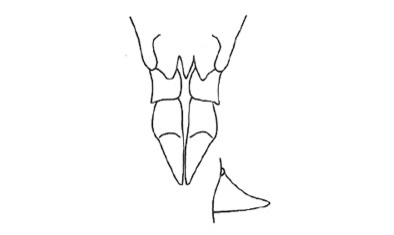
Nomenclature (4)
- Poecilocloeus flavipicta Bruner, 1913: 484.
Holotype; female; 4ef26cfd-45fe-4591-8483-4a79bc480da3; deposited at: Academy of Natural Sciences of Philadelphia (ANSP); Bolivia: Santa Cruz: Santa Cruz de la Sierra
- Poecilocloeus flavopictus [sic] Bruner, 1913 in Descamps, 1976: 142.
- Poecilocloeus flavopictus [sic] Bruner, 1913 (misspelling of Poecilocloeus flavipicta Bruner, 1913)
- Poecilocloeus flavopictus [sic] Bruner, 1913 in Otte, 1995: 451.
Nomenclature references (3)
- Bruner, L. (1913) South American locusts (Acridoidea) II. Annals of the Carnegie Museum, 8(3-4), 423–506. Available at http://www.biodiversitylibrary.org/item/37006
- Descamps, M. (1976) La faune dendrophile neotropicale. I. Revue des Proctolabinae (Orth. Acrididae). Acrida, 5(2), 62–167.
- Otte, D. (1995) Orthoptera Species File 5, Grasshoppers [Acridomorpha] D. The Orthopterists' Society and The Academy of Natural Sciences of Philadelphia, Philadelphia, 630 pp.
Descendants and synonyms
Gender, form, and etymology
Etymology:
Relating to six large lemony-yellow patches on pronotum and citron yellow coloration of pleura and abdomen.
Stats
| Valid names | |||||
|---|---|---|---|---|---|
| Rank | Extant | Fossil | Invalid | Total | |
| species | 1 | 0 | 1 | 2 | |