
Species
Obolopteryx poecila (Hebard, 1932)
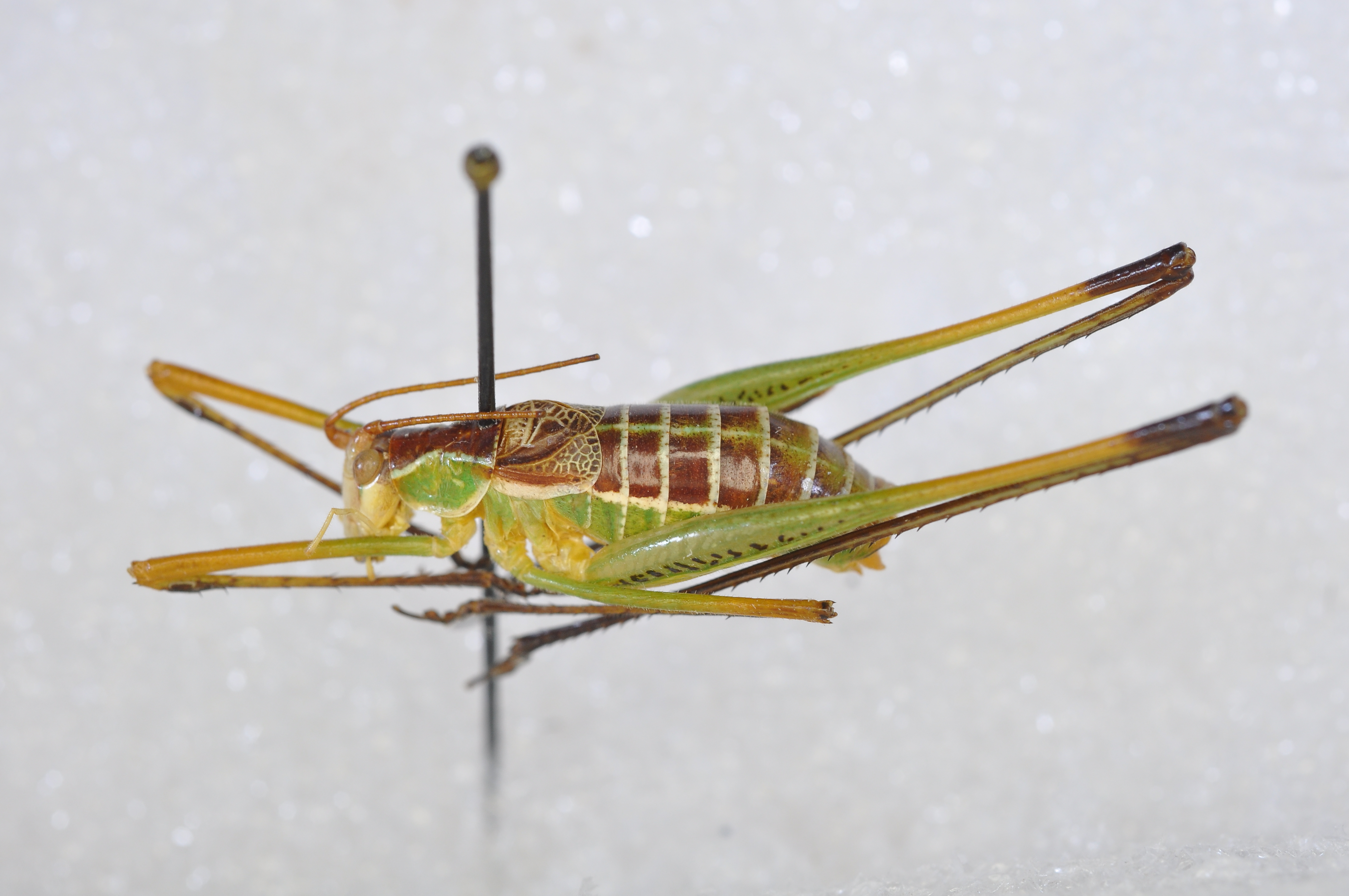
Nomenclature (5)
- Dichopetala poecila Hebard, 1932: 299.
Holotype; male; d0af767a-cfce-480f-a3ef-73facfe042a3; deposited at: Academy of Natural Sciences of Philadelphia (ANSP); Mexico: Tamaulipas: El Mante
- Dichopetala poecila Hebard, 1932 in Strohecker, 1945: 210.
- Obolopteryx poecila (Hebard, 1932) in Cohn, Swanson & Fontana, 2014: 31.
- Obolopteryx poecila (Hebard, 1932) in Barrientos-Lozano, Rocha-Sánchez, Zaldívar-Riverón & Correa-Sandoval, 2016
References (5)
- Hebard, M. (1932) New species and records of Mexican Orthoptera. Transactions of the American Entomological Society, 58(3), 201–371. Available at http://reader.library.cornell.edu/docviewer/digital?id=chla5077659_4268_003#page/2/mode/1up
- Strohecker, H.F. (1945) Notes on and descriptions of Mexican Orthoptera. Annals of the Entomological Society of America, 38(2), 207–215.
- Cohn, T.J., Swanson, D.R. & Fontana, P. (2014) Dichopetala and new related North American genera: a study in genitalic similarity in sympatry and genitalic differences in allopatry (Tettigoniidae: Phaneropterinae: Odonturini). In Miscellaneous Publications Museum of Zoology University of Michigan. Vol. 203, 1–180 pp. Available at http://deepblue.lib.umich.edu/handle/2027.42/122723
- Barrientos-Lozano, L., Rocha-Sánchez, A.Y., Zaldívar-Riverón, A. & Correa-Sandoval, A. (2016) Additional new species of the genus Obolopteryx Cohn et al. 2014 (Ensifera: Tettigoniidae) from Northeastern Mexico. Zootaxa, 4168(3), 401–452.
Descendants and synonyms
Gender, form, and etymology
Etymology:
Greek, ποικίλος, poecilos, varicolored, pied, mottled, spotted. The epithet probably references the vibrant coloration of live specimens.
Stats
| Taxon | Valid names | |||
|---|---|---|---|---|
| Rank | Extant | Fossil | Invalid | Total |
| Species | 1 | 0 | 1 | 2 |