
species
Mactruchus serrifer (Rehn & Hebard, 1914)
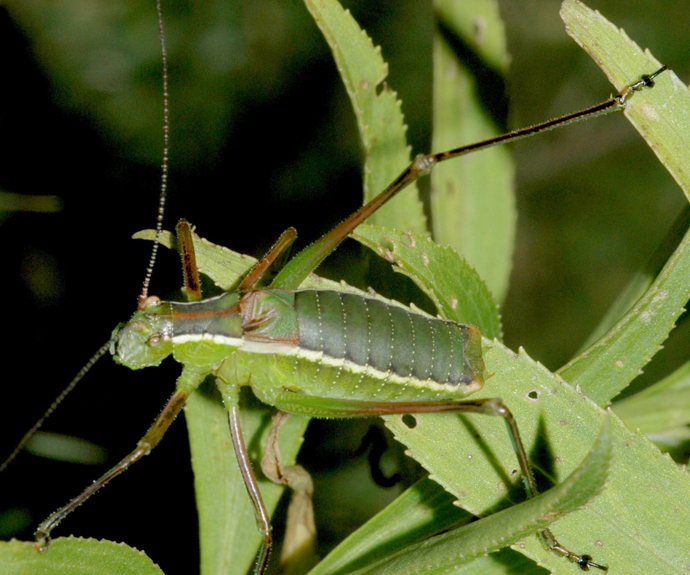
Nomenclature (9)
- Dichopetala serrifera Rehn & Hebard, 1914: 82.
Holotype; male; a95872c2-1be8-4492-8804-339e9b93155e; deposited at: American Museum of Natural History (AMNH); Mexico: Jalisco: 12 km N Guadalajara, Barranca
- Dichopetala serrifera Rehn & Hebard, 1914 in Hebard, 1932: 299.
- ... Show all ... (5)
- Mactruchus serrifer (Rehn & Hebard, 1914) in Cohn, Swanson & Fontana, 2014: 44.
- Mactruchus serrifer (Rehn & Hebard, 1914) in Kensinger, Schwemm & Luttbeg, 2017: 10.
Nomenclature references (8)
- Cohn, T.J., Swanson, D.R. & Fontana, P. (2014) Dichopetala and new related North American genera: a study in genitalic similarity in sympatry and genitalic differences in allopatry (Tettigoniidae: Phaneropterinae: Odonturini). In Miscellaneous Publications Museum of Zoology University of Michigan. Vol. 203, 1–180 pp. Available at http://deepblue.lib.umich.edu/handle/2027.42/122723
- Fontana, P., Buzzetti, F.M. & Mariño-Pérez, R. (2008) In Chapulines, Langostas, Grillos y Esperanzas de México. Guía fotográfica - Grasshoppers, Locusts, Crickets & Katydids of Mexico. Photographic guide. World Biodiversity Association, Verona, Italy. 1–272 pp. Available at http://biodiversityassociation.org/wp-content/uploads/2016/05/Grasshoppers-Locusts-Crickets-Katydids-Of-Mexico.pdf
- ... Show all ... (4)
- Márquez Mayaudón, C. (1969) Estudio comparativo de los genitales externos y de los cromosomas de algunos grupos de la subfamilia Phaneropterinae (Orthoptera, Tettigoniidae) de Mexico. Anales del Instituto de Biología, Universidad Nacional Autónoma de México. Serie Zoologia, 40(1), 55–102.
- Rehn, J.A.G. & Hebard, M. (1914) A study of the species of the genus Dichopetala (Orthoptera, Tettigoniidae). Proceedings of the Academy of Natural Sciences of Philadelphia, 66, 64–160. Available at http://www.biodiversitylibrary.org/page/1856461/#page/72/mode/1up
Descendants and synonyms
Gender, form, and etymology
Etymology:
Latin, serratus, saw; Latin, -fer, suffix meaning bearing. No explanation was given in the original description. The epithet was surely chosen to reference the teeth present on the dorsal ridge of the male cercus.
Stats
| Taxon | Valid names | |||
|---|---|---|---|---|
| Rank | Extant | Fossil | Invalid | Total |
| species | 1 | 0 | 2 | 3 |